How the European Commission measures cloud sovereignty
Who controls the service, its keys and its operations? The European Commission uses the Cloud Sovereignty Framework to assess bids in its tender. Here are six questions for your provider.
Go to the six questions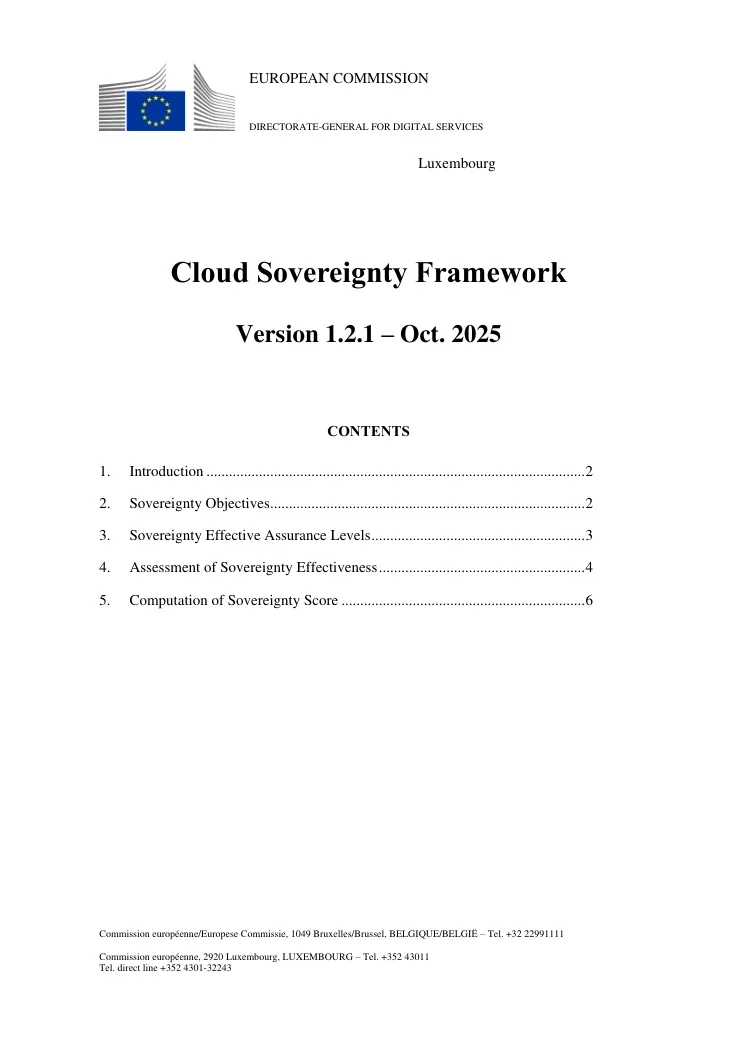 European Commission · October 2025Read the framework (PDF)
How is a cloud service assessed?
Where a service stores data tells you little about who can keep it running if a technology supplier withdraws support. The Commission’s Cloud Sovereignty Framework considers both questions. The contracting authority assesses tenderers’ answers and can draw on supporting evidence and public documentation about the service.
SEAL checks whether a tender meets the minimum requirements
The authority assesses each objective on a scale from 0 to 4. The tender specifications set the minimum level for each objective. A tender that falls short on any objective is rejected.
The weighted score compares offers
Answers to the same questions also feed into the overall Sovereignty Score, which contributes to the quality assessment of the tender. A high score cannot offset a missed minimum requirement.
Eight objectives and their share of the score
Complior has summarised each objective as a question. The percentages apply to this procurement. The Commission took into account safeguards already present in its legal and security requirements.
- SOV-1 Strategy and governance
- Who owns the provider and who has the final say over the service?15 %
- SOV-2 Legal rights and jurisdiction
- Which jurisdictions apply and which authorities could require access?10 %
- SOV-3 Data and AI
- Where is information processed, who controls access and what visibility does the customer have into AI use?10 %
- SOV-4 Operations
- Who can operate, maintain and support the service if an external supplier is lost?15 %
- SOV-5 Supply chain
- Where do hardware, firmware and software come from? How far down the chain can suppliers be audited?20 %
- SOV-6 Technology
- Which open standards and documented interfaces make it possible to inspect or switch technologies?15 %
- SOV-7 Security and compliance
- Who controls security operations and what evidence is available for incident response and audit?10 %
- SOV-8 Environmental sustainability
- How does the provider track energy use, resource dependencies and equipment reuse?5 %
Six questions for your cloud provider
Choose a system your organisation relies on. Here is what Complior suggests asking your provider to show you for that system.
Who can make decisions about the service?
Ask for an overview of ownership, contracting parties and key subcontractors. Ask how a change of ownership would affect your service.
Where is your data processed and who can access it?
Ask to see the data flows for production, backup and support. If AI is involved, ask where processing takes place and how you can review access.
What happens when a key is blocked?
Ask the provider to show where master keys and data keys are used. Review which requests are blocked and whether previously available data or cached keys can still be used.
Who keeps the service running if support ends?
Ask for an example of a critical dependency, such as security updates from a third party. Find out who can maintain the system if those updates stop.
How can you recover or move the system?
Ask for the results of a test restore. Check how you would move data, keys and permissions if you needed to switch environments.
What evidence can you review regularly?
Ask for a sample report, its scope and how you would follow up a finding. Also ask how the provider reports energy use and equipment lifespan.
Protecting systems in your existing cloud
Your systems can stay in Microsoft Azure, AWS, Google Cloud (GCP) or Oracle Cloud. Together we review which of the four controls suit your data and which integrations your cloud services support.
Separate backups
You can keep a backup at Complior separate from production. Choose the data you need to recover and test the restore.
Log analysis
Bring logs from selected cloud services together in Complior’s SIEM to trace events and investigate incidents.
Identity and access
With IDombud you can control who can sign in and review access when someone changes roles or leaves.
Encryption with key management outside the cloud service
A municipality that temporarily moved its servers to Azure used a client for encryption and a separate key service operated by Complior in Sweden. In Scrive’s AWS deployment, Complior holds the root keys. For your environment, we review which keys are held externally, where data is decrypted and what happens if a key request is denied.
Sources and further reading
Sources reviewed on .